P2P vs traditional IPTV: benefits and real differences
P2P vs traditional IPTV: how peer-to-peer delivery can share traffic more efficiently, where it helps and why testing on your own device matters.
In this guide
- What are we actually comparing?
- How does P2P work in simple terms?
- Advantage 1: more efficient traffic distribution
- Advantage 2: participants can contribute additional capacity
- Advantage 3: access to chunks from multiple sources
- Where does traditional IPTV have limitations?
- How much better is P2P?
- How does this apply to Vox Max?
- What should you check during the trial?
- Frequently asked questions
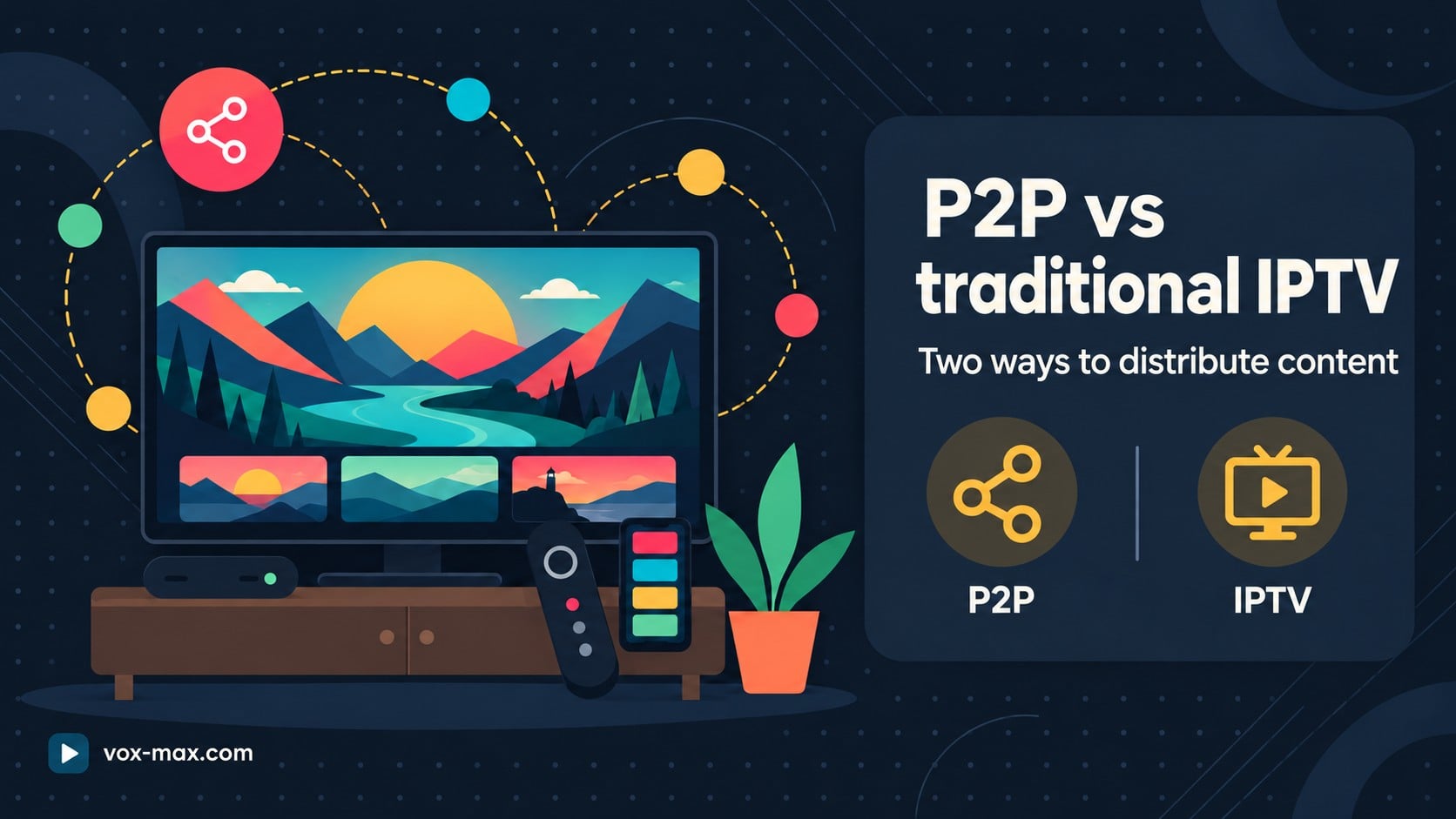
In a P2P vs traditional IPTV comparison, P2P's main advantage is how it distributes content: participating devices can help pass on video chunks instead of only receiving them. This cooperation can use available resources more efficiently and reduce pressure on the delivery infrastructure when many people watch the same programme.
For you, the result matters: how quickly channels start, whether playback stays smooth and how the app behaves on your device. P2P can contribute to a good experience, but its benefits need to be assessed in real conditions.
What are we actually comparing?
IPTV is a broad term for television delivered using Internet Protocol. P2P, short for peer-to-peer, describes a method of distributing data. The terms are not always opposites: an internet television solution can also incorporate P2P mechanisms.
In this article, “traditional IPTV” means a model in which your device receives a stream from the provider's infrastructure without helping distribute it to other participants. We compare that model with cooperative P2P delivery, rather than making claims about every internet TV service.
How does P2P work in simple terms?
Imagine a broadcast divided into small chunks. The app receives the chunks it needs, puts them in the correct order and plays the video. In a P2P system, participants can pass on chunks they have already received.
Devices can therefore contribute some of their upload capacity. The app manages the process; you do not need to copy files or manually configure connections between devices.
This is the essential difference: participants can add resources to the network as well as creating demand by watching. The value comes from sharing the delivery work across available connections.
Advantage 1: more efficient traffic distribution
In a model without sharing between participants, delivery to viewers depends on the capacity provided by the supplier and its delivery network.
P2P allows devices to share part of this work. When people watch the same content at the same time, available chunks can circulate between participants, reducing some of the traffic that the service infrastructure must deliver directly.
The benefit is distribution efficiency. It does not automatically mean a higher-resolution picture; it is a different way of transporting content to the people watching it.
Advantage 2: participants can contribute additional capacity
In a well-implemented P2P system, a growing audience can also bring additional upload resources. This is an advantage over a model where every new viewer only adds to traffic demand.
However, the number of viewers is not enough on its own. Their upload speeds, connection quality, available chunks and the way the app selects participants all matter.
The accurate claim is that P2P can support audience growth efficiently, not that every additional viewer automatically makes a broadcast faster. A useful contribution depends on the resources that participant can actually provide.
Advantage 3: access to chunks from multiple sources
P2P delivery can allow video chunks to be obtained from different participants. If one becomes unavailable, the app may look elsewhere for the chunks it needs, depending on the implementation and their availability.
This flexibility can help maintain playback. It does not eliminate problems with the original broadcast, internet connection failures or device limitations.
The practical benefit is having additional delivery options that can help when the network is properly designed and managed. Those options are useful only when the required content is available in time for playback.
Where does traditional IPTV have limitations?
A delivery model without contributions from participants has several limitations in this comparison:
- Audience growth creates additional demand without adding upload capacity from viewers.
- At busy times, insufficient delivery capacity can affect playback.
- Resources available on participating devices are not used to deliver content to other viewers.
These limitations do not mean every IPTV service performs poorly. Well-designed delivery networks and technologies such as multicast can serve large audiences efficiently. The difference should be judged by implementation and results, rather than the label alone.
How much better is P2P?
There is no universal percentage. It would not be accurate to say P2P is “twice as fast” or completely eliminates interruptions without measurements taken under comparable conditions.
Its advantages are clearest in resource distribution and participant contributions. Channel start-up times, broadcast delay and stability depend on the app, network and device.
Picture quality is not determined by P2P or IPTV alone either. The video source, compression, bitrate and the device's ability to decode the content all play an essential role. A better delivery method cannot restore detail that was absent from the original video.
How does this apply to Vox Max?
Vox Max uses P2P technology through its dedicated app. For television viewing, see the Vox Max Android TV installation guide. If you have a Samsung or LG television, read why we recommend a compatible Android TV device.
Choose the app appropriate for your device and test it under the conditions in which you normally watch programmes. The free 24-hour trial lets you assess the experience before choosing a subscription.
What should you check during the trial?
- Watch several channels, including in the evening if that is your usual viewing time.
- Observe start-up times and playback continuity over a longer session.
- Check sound synchronisation and picture smoothness.
- Compare Wi-Fi with a wired connection if your device supports it.
- Try the available features and check how responsively the app behaves.
If problems occur, check your connection and device before attributing the cause to the distribution technology. A high download speed alone does not guarantee a stable connection; upload performance can matter in P2P too.
Frequently asked questions
Does P2P work without the internet?
No. You need an internet connection, and its quality affects the viewing experience.
Does P2P guarantee uninterrupted playback?
No. It can offer delivery advantages, but playback also depends on the broadcast source, network, app and device.
Does P2P automatically hide my IP address?
No. P2P is not inherently an anonymity system. Encryption and IP address protection are separate mechanisms that need to be assessed for each service.
Does P2P use upload bandwidth?
Yes. A P2P implementation can use upload bandwidth to send video chunks to other participants. Actual usage depends on how the app operates.
How do I decide whether the service suits me?
Test it on your own device and connection, then review the Vox Max subscription plans and frequently asked questions. The experience you observe in everyday use is more useful than a general promise about technology.
Technical reference for peer-to-peer distribution: IETF — Peer-to-Peer Streaming Peer Protocol, RFC 7574.

More guides
-
Romanian TV abroad
P2P streaming in the UK: Romanian TV on Android devices
P2P streaming in the UK with Vox Max: learn how the technology works, explore its benefits and try Romanian TV on your television or Android mobile device.
-
Setup and devices
How to install Vox Max on Android TV: step-by-step guide
Install Vox Max from Google Play or with Downloader, sign in with your emailed details, and fix the most common setup problems.
-
Romanian TV abroad
Romanian TV in Austria Without a Satellite Dish: Setup Guide
Watch Romanian TV in Austria on a compatible Android TV device or Android phone. Learn which app to install and what to check during the free 24-hour trial.